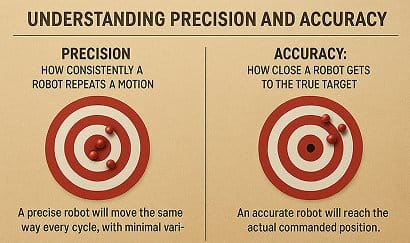
Robotics is the backbone of modern manufacturing, and as cycle times shrink and quality requirements tighten, the distinction between precision and accuracy becomes more critical. Engineers often use the terms interchangeably, yet they describe fundamentally different performance characteristics of a robotic system. Understanding the difference is essential for anyone designing, integrating, or evaluating robot accuracy in automated inspection, machining, assembly, or calibration workflows.
This article breaks down the technical definitions, how they affect performance, the factors that influence each, and practical strategies to improve both.
Understanding Precision and Accuracy in Robotics
In robotics and metrology, precision and accuracy refer to different—yet complementary—measurement characteristics.
Precision (Repeatability)
Precision describes how consistently a robot can return to the same position under identical conditions.
Formally:
Precision = \text{Variance or spread in repeated measurements}
Robot manufacturers typically specify precision as:
\pm 0.02 \text{ mm to } \pm 0.05 \text{ mm}
This number reflects the robot’s ability to perform identical moves repeatedly, regardless of how close those moves are to the “true” or intended target.
Accuracy (Absolute Accuracy)
Accuracy describes how close the robot’s actual position is to the intended or commanded target.
Formally:
Accuracy = |x_{true} – x_{measured}|
Industrial robots, without calibration, are not accurate systems. Their typical absolute accuracy ranges from:
1.0 \text{ mm to } 2.0 \text{ mm}
Why so low? Because robot joints accumulate:
kinematic parameter errors
encoder quantization errors
mechanical tolerances
link length variation
backlash
This distinction is critical because a robot can be highly precise but very inaccurate.
Example
A robot returns to the same point within ±0.03 mm every time (high precision),
but that point is 1.4 mm away from the commanded position (poor accuracy).
Why Both Precision and Accuracy Matter in Robotic Applications
Some applications require precision; others demand accuracy; many require both.
When Precision Matters
Robotic inspection
Robot-guided metrology
Machining / trimming
Weld path following
Assembly of tight-tolerance components
Calibration of multi-arm systems
Accuracy is essential any time the robot must align with external coordinate systems, sensors, or fixed datums.
When Both Matter
AI-driven inline inspection
Robot-to-CNC closed-loop workflows
Robotic deburring and grinding
High-precision dispensing
Multi-robot coordination
Any system that relies on world-frame consistency demands both high precision and high accuracy.
Factors Affecting Precision and Accuracy in Robotics
Robotic performance is influenced by mechanical, electrical, environmental, and computational factors.
1. Mechanical Factors
Joint backlash
Link rigidity
Bearing wear
Gearbox tolerances
Payload and CG shifts
These primarily affect precision, but can drift into accuracy issues over time.
2. Kinematic Parameter Errors
These impact accuracy, including:
Incorrect DH parameters
Joint zero-offset errors
Link length deviations
Tool Center Point (TCP) miscalculations
Base frame misalignment
These are the core contributors to robot inaccuracy.
3. Thermal Effects
Robots heat up due to:
H = f(\tau, speed, duty\ cycle)
Heat causes:
link expansion
encoder drift
gearbox viscosity changes
This affects both precision and accuracy, especially in high-duty-cycle operations.
4. Sensor and Encoder Limitations
Encoder resolution and quantization error influence measurement fidelity:
Ensure the robot’s tool is mathematically tied to the flange coordinate frame.
3. Base and Fixture Frame Calibration
Align the robot to external coordinate systems:
T_{base}^{world}, \ T_{tool}^{sensor}, \ T_{world}^{fixture}
4. Sensor-Guided Correction
Use vision or lasers to adjust robot paths dynamically.
5. Drift and Thermal Compensation
Real-time compensation models predict and correct robot behavior as joints warm:
\Delta x(t) = f(temperature,\ load,\ duty\ cycle)
Conclusion
Precision and accuracy are not interchangeable—they describe two completely different aspects of robot performance. Precision reflects consistency; accuracy reflects closeness to the true target. Manufacturers can buy precision out of the box, but accuracy must be calibrated.
In an era where robotics supports machining, inspection, assembly, and multi-robot coordination, understanding and improving both metrics is critical.
Robots that are only precise will repeat mistakes.
Robots that are only accurate will be inconsistent.
Robots that are both become metrology-grade automation systems.
We collect cookies to analyze our website traffic and performance; we never collect any personal data.
Functional
Always active
The technical storage or access is strictly necessary for the legitimate purpose of enabling the use of a specific service explicitly requested by the subscriber or user, or for the sole purpose of carrying out the transmission of a communication over an electronic communications network.
Preferences
The technical storage or access is necessary for the legitimate purpose of storing preferences that are not requested by the subscriber or user.
Statistics
The technical storage or access that is used exclusively for statistical purposes.The technical storage or access that is used exclusively for anonymous statistical purposes. Without a subpoena, voluntary compliance on the part of your Internet Service Provider, or additional records from a third party, information stored or retrieved for this purpose alone cannot usually be used to identify you.
Marketing
The technical storage or access is required to create user profiles to send advertising, or to track the user on a website or across several websites for similar marketing purposes.