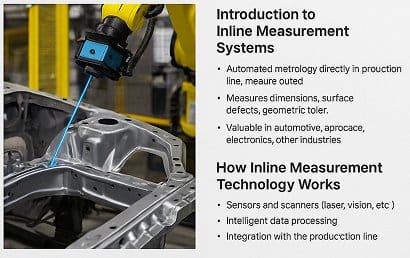
Modern manufacturing is moving faster than ever, and quality assurance must keep pace. Traditional methods that rely on offline inspection, CMM measurements, or manual gaging introduce bottlenecks, delays, and inconsistencies. To overcome those limitations, many manufacturers are turning to Inline Measurement Systems —metrology technologies integrated directly into the production line.
Inline measurement represents a significant leap forward in quality control: enabling real-time dimensional feedback, automated verification, and continuous process optimization without interrupting production flow.
This guide breaks down what inline measurement technology is, how it works, the different types of systems, core benefits, and how it compares to offline inspection.

Introduction to Inline Measurement Systems
Inline Measurement Systems are automated metrology solutions installed directly within the production process. Instead of removing parts for offline inspection, inline measurement captures dimensional or surface data as the part is being produced.
Inline systems can measure:
- Dimensions (length, width, height, thickness)
- Hole or slot positions
- Surface defects
- Gap & flush
- Geometric tolerances
- Part alignment
- Weld quality
- Runout, concentricity, flatness
- Complex free-form surfaces (with 3D scanning)
Unlike offline CMMs, inline measurement is fast enough to keep up with continuous production — often measuring parts in milliseconds.
Inline systems are valuable in industries including:
- Automotive
- EV battery and body assembly
- Aerospace
- Electronics
- Medical devices
- Metal fabrication
- Plastics and injection molding
- Packaging and consumer goods
Inline measurement technology transforms quality assurance from an after-the-fact check into a real-time process control tool.
How Inline Measurement Technology Works
Inline measurement systems combine sensors, robotics, automation, and metrology algorithms to capture accurate part data instantly. While configurations vary, most share these core components:
1. Sensors and Scanners
Inline systems use a range of sensor technologies, such as:
- Laser triangulation sensors
- 2D and 3D vision cameras
- Structured-light scanners
- Laser line profilers
- Eddy current sensors
- Capacitive and inductive probes
- Ultrasonic sensors
These sensors generate high-speed data, often thousands or millions of data points per second.
2. Intelligent Data Processing
Processing modules convert raw sensor data into metrology results by applying:
- Feature extraction
- Surface reconstruction
- Point-cloud alignment
- GD&T evaluation
- Statistical filtering
- Outlier detection
- Machine learning classification
Advanced systems create a complete dimensional map of the part in real time.
3. Integration with the Production Line
Inline systems are mounted onto:
- Conveyor lines
- Robot arms
- Gantry systems
- Rotary tables
- Fixed-frame inspection stations
This allows measurement without stopping production.
4. Real-Time Feedback
Inline measurement systems deliver actionable feedback instantly:
- Pass/fail decisions
- Tool offset correction
- Fixture or machine drift detection
- Out-of-tolerance alerts
- Predictive maintenance indicators
The result is a closed-loop automation environment where machines correct themselves before producing bad parts.
Types of Inline Measurement Systems
Inline measurement can take many forms depending on process speed, part geometry, and accuracy requirements. Below are the most widely used system categories:
1. Vision-Based Inline Measurement Systems
These rely on high-speed cameras and lighting systems to capture:
- Dimensions
- Surface characteristics
- Presence/absence checks
- Cosmetic defects
- Color/contrast issues
Often combined with AI for defect classification.
Best for:
Electronics, packaging, automotive interior parts, consumer goods.
2. Laser Line Profilers
Laser line scanners project a laser stripe across the part and capture 3D profiles at high speed.
They’re ideal for measuring:
- Gap & flush
- Weld beads
- Adhesive bead inspection
- Edge profiles
- Free-form geometries
Best for:
Automotive BIW, EV battery modules, weld seams.
3. 3D Structured-Light Scanners
These create 3D point clouds of complete surfaces using projected patterns.
Advantages:
- High-resolution 3D shape capture
- Fast acquisition time
- Ideal for complex shapes
Best for:
Injection-molded parts, castings, machined components.
4. Robot-Guided Metrology Cells
A robot (calibrated for accuracy) guides a laser scanner, probe, or vision system around the part.
Benefits:
- Flexible measurement range
- Ability to inspect large parts
- Adaptable to many product variants
Best for:
Large assemblies, aerospace structures, automotive underbodies.
5. Inline Probing or Touch Measurement Systems
A touch probe integrated into a robot, or machine performs high-precision measurement on critical features.
Best for:
Machined components, gearboxes, engine parts.
6. Inline CMM-Style Gantry Systems
These operate like high-speed CMMs but are built directly into the production flow. Not as common, but extremely precise.
Best for:
High-precision, high-volume dimensional measurement.
Benefits of Inline Measurement Technology
Inline measurement systems deliver significant advantages, especially in automated or high-throughput production environments.
1. 100% Inspection Coverage
Offline inspection often samples a small percentage of parts.
Inline systems can measure every part, preventing escapes and ensuring full traceability.
2. Faster Feedback and Process Control
The biggest benefit: real-time error detection.
Inline systems can detect:
- Tool wear
- Fixture drift
- Machine instability
- Weld variations
- Thermal expansion
- Robot path deviation
This allows corrections before defects multiply.
3. Reduced Scrap and Rework
Early detection = fewer bad parts produced.
Manufacturers often see double-digit reductions in scrap after deploying inline measurement.
4. Better Throughput and Cycle Time
Inline measurement eliminates:
- Manual gaging
- CMM bottlenecks
- Offline measurement queues
- Part handling and transfers
This speeds up the entire production process.
5. Improved Quality Consistency
Inline systems enforce standardized measurement, reducing operator influence or inconsistencies.
6. Enhanced Traceability and Data Analytics
Inline technology generates:
- Dimensional data logs
- SPC charts
- Digital part histories
- Machine performance trends
This data supports audits, compliance, and continuous improvement.
Inline vs. Offline Measurement: What’s the Difference?
Inline and offline metrology both serve important roles. Manufacturers typically use a combination of the two.
Here’s how they differ:
Inline Measurement
Location: On the production line
Purpose: Real-time feedback & 100% inspection
Strengths:
- Extremely fast
- Automated and repeatable
- Integrated directly into the process
- Ideal for high-speed, high-volume production
Limitations:
- Lower resolution than high-end lab CMMs
- Must be hardened for industrial environments
- Requires strong calibration to maintain accuracy
Offline Measurement
Location: Metrology lab or dedicated inspection area
Purpose: Verification, certification, deep analysis
Strengths:
- Highest accuracy available
- Full access to CMMs, form testers, CT scanners
- Ideal for GD&T, complex metrology, R&D
Limitations:
- Slow — cannot keep pace with production
- Sample-based inspection
- Potential bottleneck
When to Use Each
|
Best Option |
| Real-time feedback |
Inline |
| Root-cause analysis |
Offline |
| 100% part inspection |
Inline |
| Very high precision (<5-10 microns) |
Offline |
| Automated process control |
Inline |
| Customer certification reports |
Offline |
Most manufacturers use a hybrid model:
- Inline measurement catches issues fast.
- Offline measurement confirms accuracy and performs deep diagnostics.
Conclusion
Inline Measurement Systems are reshaping modern manufacturing by enabling real-time, automated, and highly repeatable inspection directly within the production process. When deployed correctly — especially alongside calibrated robots and well-designed process control strategies — inline measurement delivers:
- Higher throughput
- Reduced scrap
- Better quality consistency
- Faster production changeovers
- Stronger traceability
- A more intelligent and reliable manufacturing environment
Inline measurement is more than an inspection tool — it’s a cornerstone of smart manufacturing and future-ready automation.