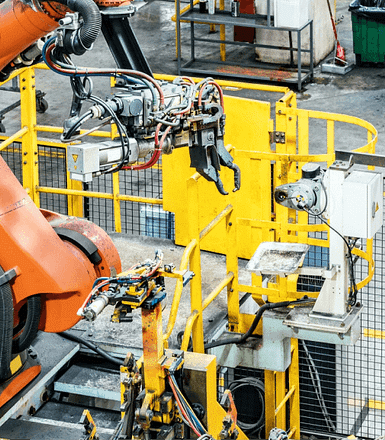
Industrial robots are often trusted because they repeat motion consistently. But a production cell can move gradually out of spec long before the problem is obvious. Parts may still come off the line. Operators may not see a visible issue. The robot may not alarm. Yet accuracy can be changing in ways that eventually produce scrap, rework, failed inspection, or unplanned downtime.
A robot accuracy audit gives manufacturers a structured way to verify whether the cell still performs as expected. It turns robot health from an assumption into measured evidence.
What Is a Robot Accuracy Audit?
A robot accuracy audit is a planned evaluation of how well a robot or robot-cell matches its expected performance. It may include repeatability checks, absolute positioning checks, TCP verification, frame validation, path verification, and comparison against a known baseline.
The purpose is not always to recalibrate immediately. Sometimes the first goal is to understand whether the robot is still within the tolerance needed for the application. A handling robot may have different requirements than a laser cutting robot, inspection robot, or precision drilling cell.
Why Production Cells Drift Out of Spec
Robot-cell accuracy can change because manufacturing environments are not static. Even when the robot itself is mechanically sound, the system around it can change.
Common drift sources include:
Thermal movement during long production runs.
Robot self-heating and ambient temperature variation.
Tool wear or tool replacement.
Fixture movement after maintenance.
Robot crash or near-crash events.
Mechanical wear in joints or reducers.
Mastering changes after service.
Base frame, user frame, or work object changes.
Sensor or process head mounting shifts.
Why Audit Timing Matters
Many teams only investigate robot accuracy after quality problems appear. By then, the cell may already have produced suspect parts. A better approach is to audit accuracy at defined moments, especially when the risk of change is high.
Useful audit triggers include:
Initial robot-cell commissioning.
After preventive maintenance or robot service.
After a crash, tool impact, or emergency stop incident.
After fixture relocation or tooling change.
Before launching a new high-accuracy program.
When duplicating programs across cells.
When inspection data begins trending toward tolerance limits.
On a scheduled cadence for high-value or high-risk production cells.
Repeatability Testing Alone Is Not Enough
Repeatability checks are useful, but they do not answer the entire accuracy question. A robot may return to the same point repeatedly while still missing the intended real-world target. For applications such as robotic inspection, cutting, sealing, welding, trimming, or precision assembly, that difference can matter.
An effective audit should help separate repeatability, absolute accuracy, TCP condition, and frame alignment. Each can create a different failure mode. Treating them as one problem leads to slower troubleshooting and weaker corrective action.
How Dynalog Fits the Audit Workflow
Dynalog’s CompuGauge system is relevant when manufacturers need robot performance analysis and evidence-based accuracy evaluation. DynaCal and DynaFlex may become relevant when the audit identifies a need for absolute calibration, recovery, or in-line compensation.
The practical value is that teams can stop relying only on symptoms. They can evaluate robot-cell performance, identify whether accuracy has changed, and decide whether recalibration, compensation, maintenance, or program correction is the right next step.
What a Useful Accuracy Audit Should Produce
A useful robot accuracy audit should produce more than a pass/fail opinion. It should give manufacturing, quality, and maintenance teams information they can act on.
Strong audit outputs may include:
Current robot-cell performance compared with baseline.
Identification of drift by workspace region or robot pose.
TCP or tool-related findings.
Frame or fixture alignment issues.
Recommended corrective action.
Evidence for customer quality or internal process documentation.
A new baseline for future comparison.
Final Takeaway
Robot accuracy audits help manufacturers detect performance changes before they become production problems. For high-accuracy robotic applications, the best time to find drift is before quality escapes, downtime, or manual re-teaching forces the issue. Measured performance is the foundation for reliable automation.
Frequently Asked Questions
Q. What is a robot accuracy audit?
A. A robot accuracy audit is a measured evaluation of whether a robot or robot-cell still performs within the accuracy required for its production application.
Q. How often should robot accuracy be audited?
A. The right cadence depends on the application, but audits are especially useful after commissioning, maintenance, crashes, fixture moves, tool changes, or when quality trends begin to shift.
Q. Is repeatability testing the same as an accuracy audit?
A. No. Repeatability testing checks whether the robot can return to the same position. An accuracy audit evaluates whether that position matches the intended real-world target and cell geometry.
Q. What are signs that a robot cell is drifting?
A. Signs include rising scrap, more touchup, shifting inspection data, inconsistent results across similar cells, or programs that gradually require operator adjustment.
Q. Which Dynalog solution supports robot performance analysis?
A. CompuGauge is relevant for robot performance analysis, while DynaCal and DynaFlex may support calibration, recovery, and compensation depending on the application.
Closing CTA
If you do not have a current accuracy baseline for a critical robot cell, Dynalog can help you evaluate whether performance analysis, calibration, or compensation is the right next step.
We collect cookies to analyze our website traffic and performance; we never collect any personal data.
Functional
Always active
The technical storage or access is strictly necessary for the legitimate purpose of enabling the use of a specific service explicitly requested by the subscriber or user, or for the sole purpose of carrying out the transmission of a communication over an electronic communications network.
Preferences
The technical storage or access is necessary for the legitimate purpose of storing preferences that are not requested by the subscriber or user.
Statistics
The technical storage or access that is used exclusively for statistical purposes.The technical storage or access that is used exclusively for anonymous statistical purposes. Without a subpoena, voluntary compliance on the part of your Internet Service Provider, or additional records from a third party, information stored or retrieved for this purpose alone cannot usually be used to identify you.
Marketing
The technical storage or access is required to create user profiles to send advertising, or to track the user on a website or across several websites for similar marketing purposes.