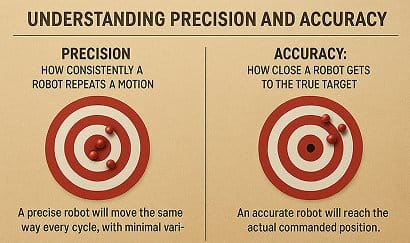
Robotics is the backbone of modern manufacturing, and as cycle times shrink and quality requirements tighten, the distinction between precision and accuracy becomes more critical. Engineers often use the terms interchangeably, yet they describe fundamentally different performance characteristics of a robotic system. Understanding the difference is essential for anyone designing, integrating, or evaluating robot accuracy in automated inspection, machining, assembly, or calibration workflows.
This article breaks down the technical definitions, how they affect performance, the factors that influence each, and practical strategies to improve both.

Understanding Precision and Accuracy in Robotics
In robotics and metrology, precision and accuracy refer to different—yet complementary—measurement characteristics.
Precision (Repeatability)
Precision describes how consistently a robot can return to the same position under identical conditions.
Formally:
Precision = \text{Variance or spread in repeated measurements}
Robot manufacturers typically specify precision as:
\pm 0.02 \text{ mm to } \pm 0.05 \text{ mm}
This number reflects the robot’s ability to perform identical moves repeatedly, regardless of how close those moves are to the “true” or intended target.
Accuracy (Absolute Accuracy)
Accuracy describes how close the robot’s actual position is to the intended or commanded target.
Formally:
Accuracy = |x_{true} – x_{measured}|
Industrial robots, without calibration, are not accurate systems. Their typical absolute accuracy ranges from:
1.0 \text{ mm to } 2.0 \text{ mm}
Why so low? Because robot joints accumulate:
- kinematic parameter errors
- encoder quantization errors
- mechanical tolerances
- link length variation
- backlash
This distinction is critical because a robot can be highly precise but very inaccurate.
Example
A robot returns to the same point within ±0.03 mm every time (high precision),
but that point is 1.4 mm away from the commanded position (poor accuracy).
Why Both Precision and Accuracy Matter in Robotic Applications
Some applications require precision; others demand accuracy; many require both.
When Precision Matters
- Robotic inspection
- Robot-guided metrology
- Machining / trimming
- Weld path following
- Assembly of tight-tolerance components
- Calibration of multi-arm systems
Accuracy is essential any time the robot must align with external coordinate systems, sensors, or fixed datums.
When Both Matter
- AI-driven inline inspection
- Robot-to-CNC closed-loop workflows
- Robotic deburring and grinding
- High-precision dispensing
- Multi-robot coordination
Any system that relies on world-frame consistency demands both high precision and high accuracy.
Factors Affecting Precision and Accuracy in Robotics
Robotic performance is influenced by mechanical, electrical, environmental, and computational factors.
1. Mechanical Factors
- Joint backlash
- Link rigidity
- Bearing wear
- Gearbox tolerances
- Payload and CG shifts
These primarily affect precision, but can drift into accuracy issues over time.
2. Kinematic Parameter Errors
These impact accuracy, including:
- Incorrect DH parameters
- Joint zero-offset errors
- Link length deviations
- Tool Center Point (TCP) miscalculations
- Base frame misalignment
These are the core contributors to robot inaccuracy.
3. Thermal Effects
Robots heat up due to:
H = f(\tau, speed, duty\ cycle)
Heat causes:
- link expansion
- encoder drift
- gearbox viscosity changes
This affects both precision and accuracy, especially in high-duty-cycle operations.
4. Sensor and Encoder Limitations
Encoder resolution and quantization error influence measurement fidelity:
Error_{encoder} \propto \frac{1}{counts\ per\ revolution}
5. Load Variation
Changing payloads affect:
- inertia
- arm compliance
- dynamic response
A robot calibrated with a light tool but running with a heavy tool will lose accuracy.
6. External Disturbances
- Vibration
- Floor settling
- Fixture movement
- Temperature gradients
- Cable forces
Small disturbances accumulate into millimeter-scale errors over time.
Improving Precision and Accuracy in Robotic Systems
Improving robotic performance requires different strategies depending on whether you are targeting precision, accuracy, or both.
Improving Precision (Repeatability)
Improvement strategies include:
1. Mechanical Maintenance
- Replace worn bearings/gearboxes
- Tighten couplings
- Reduce backlash
- Verify payload balancing
2. Robot Warm-Up Cycles
Allow joints to reach thermal equilibrium before precision tasks.
Manufacturers recommend warm-up motions:
30 – 45\ minutes
3. Environmental Stabilization
- Reduce vibration
- Improve foundation stiffness
- Add thermal insulation
Improving Accuracy (Absolute Accuracy)
Accuracy requires calibration—the real compensation work that Dynalog is known for.
1. Kinematic Calibration
Solve for real DH parameters:
T_{model}(p + \Delta p)
Where:
- \Delta p accounts for link and joint parameter errors
- compensation improves robot-space alignment
This reduces absolute error from:
1.5 \text{ mm} \rightarrow 0.2 \text{ mm}
2. TCP Calibration
Ensure the robot’s tool is mathematically tied to the flange coordinate frame.
3. Base and Fixture Frame Calibration
Align the robot to external coordinate systems:
T_{base}^{world}, \ T_{tool}^{sensor}, \ T_{world}^{fixture}
4. Sensor-Guided Correction
Use vision or lasers to adjust robot paths dynamically.
5. Drift and Thermal Compensation
Real-time compensation models predict and correct robot behavior as joints warm:
\Delta x(t) = f(temperature,\ load,\ duty\ cycle)
Conclusion
Precision and accuracy are not interchangeable—they describe two completely different aspects of robot performance. Precision reflects consistency; accuracy reflects closeness to the true target. Manufacturers can buy precision out of the box, but accuracy must be calibrated.
In an era where robotics supports machining, inspection, assembly, and multi-robot coordination, understanding and improving both metrics is critical.
Robots that are only precise will repeat mistakes.
Robots that are only accurate will be inconsistent.
Robots that are both become metrology-grade automation systems.