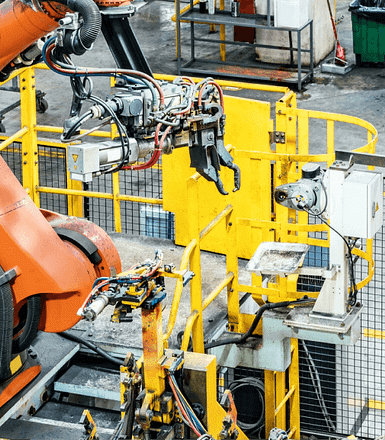
As robotic systems become more complex and production demands increase, traditional robot programming methods are no longer sufficient. Manufacturers are under pressure to deploy robots faster, reduce downtime, and adapt to frequent product changes without sacrificing accuracy or safety.
Offline Robot Programming (OLP) addresses these challenges by shifting robot programming from the factory floor to a virtual environment. By decoupling programming from physical production, OLP enables faster deployment, smoother commissioning, and more resilient automation strategies.
What Is Offline Robot Programming?
Offline Robot Programming is the process of creating, testing, and validating robot programs in a virtual simulation environment, rather than directly on the physical robot.
Using accurate digital models of:
Robots and controllers
Tooling and end effectors
Parts and fixtures
Workcells and reference frames
engineers can generate robot paths, optimize motion, and validate reach, clearance, and cycle time before the robot ever moves on the shop floor.
Offline Robot Programming vs Online Robot Programming
Online Robot Programming (Traditional Approach)
Online programming requires the robot to be taken out of production while paths are taught manually using a pendant. While simple for basic tasks, this method introduces several limitations:
Production downtime during programming
Increased risk of collisions or crashes
Longer deployment timelines
Heavy reliance on skilled operators
In high-volume or safety-critical environments, these drawbacks quickly become unacceptable.
Offline Robot Programming (Modern Approach)
Offline programming eliminates these constraints by allowing programming to occur independently of live production.
Key advantages include:
No line stoppage during program creation
Safer testing in a virtual environment
Faster iteration and optimization
Easier adaptation to new parts or variants
For manufacturers operating multiple robotic cells, OLP enables standardized, repeatable deployment across facilities.
How Offline Robot Programming Accelerates Deployment?
Offline Robot Programming accelerates deployment by compressing the automation lifecycle:
Parallel Workstreams
Programming, simulation, and mechanical integration can occur simultaneously rather than sequentially.
Virtual Validation Before Installation
Reachability, collision detection, and cycle time are validated before the robot is powered on.
Reduced On-Site Debugging
Programs arrive at the factory floor closer to “production-ready,” minimizing trial-and-error tuning.
Faster Changeovers
New product introductions and engineering changes can be accommodated without stopping production.
The result is a shorter time from concept to production and a more predictable deployment schedule.
The Role of Digital Twins in Offline Robot Programming
Offline programming relies heavily on accurate digital twins. A digital twin is not merely a geometric model it represents the kinematic, spatial, and logical behavior of the robotic system.
When properly implemented, digital twins enable:
Accurate path planning and timing analysis
Validation of reference frames and tooling offsets
Early identification of integration issues
However, the value of OLP depends on the fidelity of the underlying models. Inaccurate kinematics or misaligned reference frames can undermine the transition from simulation to reality.
Why Offline Programming Alone Is Not Enough?
Offline Robot Programming accelerates deployment but it does not guarantee accuracy. A simulated robot may execute a perfect path virtually while deviating physically due to:
Kinematic inaccuracies
Calibration drift
Tool center point (TCP) misalignment
Reference frame inconsistencies
This is where many deployments stall: the virtual program is correct, but the physical system is not.
How Dynalog Enables Reliable Offline Robot Programming?
Dynalog approaches Offline Robot Programming as part of a system-level accuracy strategy.
Rather than treating OLP as a standalone software solution, Dynalog ensures that:
Robot kinematics are accurately modeled
Reference frames are correctly established and maintained
Calibration integrity aligns virtual paths with physical reality
By closing the gap between simulation and execution, Dynalog helps manufacturers realize the full benefit of offline programming faster deployment without sacrificing accuracy.
👉 Learn how Dynalog aligns offline programming with real-world robotic accuracy: Dynalog – Robot Accuracy & Calibration
We collect cookies to analyze our website traffic and performance; we never collect any personal data.
Functional
Always active
The technical storage or access is strictly necessary for the legitimate purpose of enabling the use of a specific service explicitly requested by the subscriber or user, or for the sole purpose of carrying out the transmission of a communication over an electronic communications network.
Preferences
The technical storage or access is necessary for the legitimate purpose of storing preferences that are not requested by the subscriber or user.
Statistics
The technical storage or access that is used exclusively for statistical purposes.The technical storage or access that is used exclusively for anonymous statistical purposes. Without a subpoena, voluntary compliance on the part of your Internet Service Provider, or additional records from a third party, information stored or retrieved for this purpose alone cannot usually be used to identify you.
Marketing
The technical storage or access is required to create user profiles to send advertising, or to track the user on a website or across several websites for similar marketing purposes.