In today’s dynamic manufacturing environment, flexibility is key. Whether a Robot-Cell is performing water jet cutting, spot welding, sealing, or assembly, production teams need the ability to transfer robot programs between multiple cells with speed and precision—without disrupting production.
This flexibility might involve:
Moving a program from simulation to the real floor (OLP),
Transferring from one production Robot-Cell to another (Cloning),
Relocating the same cell to a different site (Moving),
Or recovering from a mechanical failure (Maintenance).
What Makes Up a Robot-Cell?
A typical Robot-Cell includes:
The Robot,
An End-Effector
A Fixture, which holds the part or workpiece.
These components work together to perform specific tasks within a tightly defined workspace. The Fixture may be static or dynamically positioned with multiple axes of movement (such as a track or positioner).
From Physical to Digital: Nominal vs. Actual Robot-Cell
Manufacturers use Nominal CAD models to digitally represent these physical components—known collectively as the Nominal Robot-Cell. In contrast, the real-world components on the floor make up the Actual Robot-Cell.
These CAD-based models allow engineers to simulate robot paths using software before deployment. In theory, if a Nominal Robot-Cell perfectly matched its physical counterpart, robot programs could be sent straight to the plant floor with perfect results.
But Here’s the Problem: Tolerances Matter
Manufacturing tolerances, however small, cause discrepancies between the nominal and actual dimensions. These deviations can lead to:
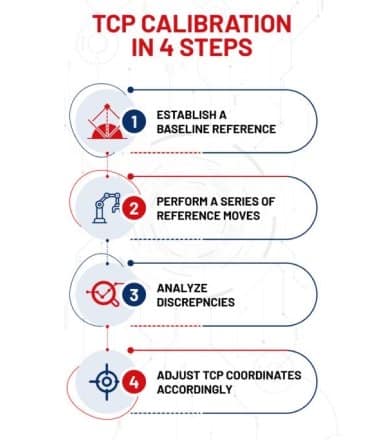
Misaligned Tool Center Points (TCP),
Inaccurate movements,
Even collisions between the robot, its end-effector, and the fixture.
This is especially problematic in high-precision applications like engine assembly, where small errors can have significant consequences.
We collect cookies to analyze our website traffic and performance; we never collect any personal data.
Functional
Always active
The technical storage or access is strictly necessary for the legitimate purpose of enabling the use of a specific service explicitly requested by the subscriber or user, or for the sole purpose of carrying out the transmission of a communication over an electronic communications network.
Preferences
The technical storage or access is necessary for the legitimate purpose of storing preferences that are not requested by the subscriber or user.
Statistics
The technical storage or access that is used exclusively for statistical purposes.The technical storage or access that is used exclusively for anonymous statistical purposes. Without a subpoena, voluntary compliance on the part of your Internet Service Provider, or additional records from a third party, information stored or retrieved for this purpose alone cannot usually be used to identify you.
Marketing
The technical storage or access is required to create user profiles to send advertising, or to track the user on a website or across several websites for similar marketing purposes.